Tuesday, June 25, 2013

The Limits of Academic Feminism

I was musing on the annoying (and often oppressive) nature of many academy-educated feminists after a dear friend came to me ranting about the antics of a mutual acquaintance.

To clarify, by academy-educated feminist, I don't mean a feminist that has been educated in academia or holds a degree in higher education. I mean feminists who received all or most of their education about feminisms in the academy, whose entire view of feminism has been shaped solely by the power dynamics present in each and every university classroom (yes, even the gender studies courses).

Looking back, my gender studies classes provided very little of what makes up my identity as Feminist today. I left school gung-ho about abortion rights and, while I had some vocabulary to discuss intersectionality, my Feminism was largely limited and, at times, point-blank oppressive.

This isn't uncommon. Look at any syllabus for a survey feminist theory course and you'll find pretty much the same format:
  • First Wave Feminism - Susan B. Anthony, Elizabeth Cady Stanton, suffrage, and a white lady's account of Sojourner Truth.
  • Second Wave Feminism - Betty Friedan, Gloria Steinem, Roe v. Wade, Title IX. 
  • The 1980s - Catherine MacKinnon, Andrea Dworkin and the "feminist sex wars." Poststructuralist feminism, featuring Judith Butler and the obligatory mind blowing of fresh-faced academes. 
  • Third Wave Feminism - Really just "We're going to spend a month reading Jennifer Baumgardner."
  • Literally one or two weeks to "cover" non-mainstream feminisms - Black feminism, transfeminism, sex-positive feminism, cross-continental feminism, etc.
See the issue? All the mainstream stuff is taught chronologically, and if we have time at the end, we're going to go back in time to cover "the other stuff" that "doesn't fit" within the feminisms we're already familiar with.

A bunch of gender studies professors relegating "other" feminisms to the back of the syllabus isn't a huge surprise, of course (as I said, university power dynamics). The worst part about this trend is the five minute feelgood spiel they'd always give at the end: "Let's take a moment to reflect on how it's problematic to teach gender studies this way. ... Okay, have a great summer!"

Wait, hold on! Did you just say that everything you've been doing all semester is problematic? Can we talk about that for a moment? Maybe think of solutions?

No, because class is dismissed and everyone is jumping up from their seats to head to their next class.

(Besides, the professor's problematic syllabus probably won't be on the final.)

Thursday, April 18, 2013

My Doula Identity Crisis

For a number of reasons, I'm toying with not recertifying with DONA International next year. (The reasons are best left to a different post.) When considering my options for a new certifying organization, an interesting thought crossed my mind: why recertify at all?

Think about it. Doulas are not medical professionals; there is no such thing as "practicing labor support without a license." It doesn't take a sheet of paper and a nametag to offer holistic pregnancy and labor support. It takes training, knowledge, and most of all, a committment to your cause.

Your cause. And what is my cause? This whole inner dialogue, do I recertify or not, has driven me into a sort of Doula Identity Crisis.

Credentials or not, I am a Doula. I have always been one, and while I haven't always attended births (or, for that matter, attached that term to what I do), I have always played the Supporting Role in whatever challenge my friends and acquaintances are facing. Learning this about myself has given me the opportunity to playfully attach the term to many aspects of my life. Listening to a friend work through issues with her partner? Relationship Doula. Volunteering at Transformus' Sanctuary? Burn Doula. My partner mentioned his fire department's auxiliary. What I heard? Fire Doulas.

What we've come to forget - strangely enough - is that doulas have been attending births long before it was a paid profession. In fact we hear this history when we attend the trainings: women have been assisting women through childbirth for probably as long as childbirth has existed. Many mammals (i.e., elephants!) doula each other through labor. We know this, and yet we have allowed "those who are doulas" to be separated from "those who are not doulas" by a mess of paperwork, fees, and credentials. Even my local professional association of doulas separates certified doulas from non-certified doulas with the categories Certified Doulas and Trained Doulas Working Toward Certification.

Which leads me to ask again, What The Hell Are We Doing?

There must have been something in the air, because right as I started questioning this whole notion that "doulas are paid professionals with credentials," Miriam Perez penned an article on this very topic. She muses:
I think doula work is valuable and important, and I also don’t believe the essence of doula work—non-judgmental and unconditional support for pregnant and parenting people—needs to be locked away in a system that says only a certain amount of training, certificates, or other paperwork bestows upon someone the right to provide this support. We run the risk of replicating the model we’re trying to revolutionize. And I don’t think that is where real social change happens.
Let me pause for a moment and say that, had it not been for my training and push towards credentialing, I would not harbor the knowledge and skills I have today. I see the need for these trained and certified doulas that charge for their services, and I hope to remain one of them for a very long time. The work is invaluable, and charging for services rightfully reimburses us for the hours upon hours spent with someone's family (read: away from ours). It also helps to set a standard of practice so that families know what to expect - and not expect - from a prospective doula.

But as Perez rightly notes, we could be defeating our cause by over-stressing the importance of these things.

Last month, this piece sparked some heated discussion on my Facebook feed. On the one hand, I agree with the author that valuing our work and not selling ourselves short is important. On the other, her point completely ignores the vast number of families who should not be denied trained labor support simply because they cannot front a $500-$1000+ payment to someone who, let's face it, isn't exactly a mandatory part of the birthing process. This population, the under-served and often less educated, needs doula services the most. They are more likely to lack a constant support person throughout the process. They are more likely to be "rushed through the machine" of the hospital system. They are less likely to feel positive about their experiences. They need doulas, and anyone who says I'm "cheapening the profession" by volunteering my time to help someone have the birth they want needs to reassess the reasons they became a doula in the first place.

Fast forward to today. I have a client with one of the more medical physicians practices in this city. They've scheduled an induction for Monday, four days after her estimated due date, because "baby is measuring big." After venting about the obvious issues to a friend, I found myself thinking, "I just need to stop taking clients with this practice."

Woah woah woah woah. What am I saying?

Suppose for a moment I wasn't her doula simply because of who her doctor is. And say all other doulas felt the same way. This mama would still be induced on Monday, but I wouldn't be there to support her through it. No one would, and with a practice like this, it's these women that need my support most.

I'm envious of the doulas who "only attend home births" or "only work with patients of midwives." They are helping to support a certain portion of the population that deserves a doula as much as anyone, and I'm not saying their work as doulas is less important (far from it). However, if their goal is to only work with care providers that are already extra supportive of natural chlidbirth, then I can only imagine their mission differs from mine.

Thing is, I get it. I love working with the midwives, not worrying about contradicting a care provider's advice, not having to hide granola bars under hospital gowns, avoiding unnecessary interventions, etc. I'm excited to have two clients next month who are having water births.

But my mission is to help every person have a supported and satisfying birth. For everyone experiencing abortion or miscarriage to be validated and supported throughout the process. For all my friends and people I care about to have a non-judgmental ear, to have their backs rubbed when they need it, to be reminded to just simply take care of themselves. I'm not doing that if I'm limiting the population I'm willing to work with, and I'm certainly not doing that if I'm more concerned with my credentials and fee schedule than I am my ability to simply be there.

I have a lot to think about over the next year when my DONA certification expires. Do I want to certify with another organization? Let it go and work without cert? Does it even matter? I'm not entirely sure. What I am sure of is this: if I look at myself in the mirror and can say with confidence, "I am a Doula," I know I'm on the right track.

Monday, April 8, 2013

The Gun Thing

A lot of people don't realize that I am in no way against responsible gun ownership. I'm not a huge fan of the things, but I've shot them and - aside from that incident at summer camp where I accidentally killed a bird - I rather enjoyed the experience.

What I am against, however, are the people who incoherently rail on about the Second Amendment while not being able to tell you what, exactly, the Second Amendment actually says. Or those who evoke said amendment without understanding the context in which it was written, or the reasons why that context is deeply problematic in and of itself.

I am against any discourse that doesn't take into account the mess of white privilege tangled up in every cry for the right to keep and bear firearms. The way we push for armed guards in suburban elementary schools without any mention of the way such guards have impacted inner-city learning institutions, led to increased police brutality within schools, and reinforced the growing school-to-prison pipeline.

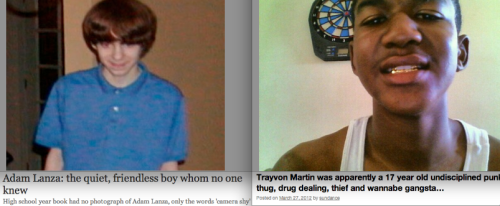
I am against the way we explain away mass shootings by white people with simple phrases like "mental illness" while blaming "thuggish" black kids for their own death at the hands of a firearm (and never suggesting they should have been carrying for their own self defense).

Those who look at George Zimmerman and believe he was truly justified in his right to self defense, but make not a peep when Melissa Alexander gets thrown away for firing warning shot near her abusive ex-husband.

Those who co-opt the language of sexual violence prevention only when it suits their pro-gun agenda, coincidentally ignoring the countless instances where possession of a firearm has made women more vulnerable to death from abuse and assault. Not to mention that this idea - that women should carry as "rape prevention" - reinforces rape culture by placing emphasis on me being responsible for protecting myself and not on a collective effort to combat systematic sexual oppression.

Those who don't see how making a case for more gun rights after a tragedy is markedly different from making a case for ways we can keep them from happening again.

Those things. I'm against those things, not gun ownership itself.

And yet, when I bring up any number of these issues, I am summarily accused by my culture's blind affinity for dichotomy of being "against responsible gun ownership." Of being a "bleeding heart liberal who wants big government to take away my rights."

I'm done with it. I am so tired of the dichotomy, of being put into defense mode, of feeling the need to relive the night I was nearly raped just to get my point across, of having my commitment to individual freedom called into question by folks with no visible care for collective justice.

So this is my final statement on the matter, one that I will probably be copy/pasting for years to come: I have no problem with your right to purchase and keep a firearm. I have a problem with you not recognizing the ways in which your arguments are ignorant, short-sighted, and oppressive.

Tuesday, March 26, 2013

Equality, assimilationist, and other buzzwords trolling my feed today

I've been trying to put into words my feelings on all these red equal signs and greater-than signs popping up on my feed all day, so I thought I'd share my thoughts on what appears to be an ingrown divide.

I was married once. And no, it didn't contribute to my liberation at all. It did, however, make living in this society a little bit easier. Filing taxes jointly, knowing I was assured health benefits and hospital visitation rights, and other protections I gained by enmeshing myself in that institution were all lovely privileges that I was thankful to have at my fingertips. I was also looked at differently: I was an adult woman living with an adult man, and we were married. There was more approval of our relationship, of the way we were living. It was more palatable to our society's views on relationships and love. Problematic at its core? Oh hell yes. Easier? You betcha.

I think you'd be hard-pressed to find any actual member of the LGBTQI community who actually thinks the right to marry will ensure total liberation for them or anyone they know. Sure, the neo-liberal tendencies in the more powerful lobbies make it seem that way. But their proponents know as much as the most radical queer motherfucker out there that the right to marry isn't about to solve the nation's health care crisis, combat institutionalized racism, end bullying, or provide housing for countless homeless queer youths. But I also don't believe their personal desire to enter into that institution sets anyone back; far from it, it is our short-sightedness on the issue that holds us back, not granting the right to those who wish to access it.

It's easy to look at this whole thing and write it off as some big movement to make every queer person look like a gay June Cleaver. The "assimilationist model" is indeed problematic, however, that you are so willing to dismiss a push for the right to marry as "totally assimilationist" is divisive and hurtful as well.

Is it possible that, for many same-sex couples living without radical separatist bubbles to call their own, a societal affirmation of their relationship will help make living their lives a little bit easier?

Press on for radical, ground-breaking change, YES. We should do that ceaselessly and without apology. You may say marriage is an oppressive institution fraught with conservative ideology, and I may partially agree with you, but still... what's really the harm in granting others the right to marry if they so choose?

Sunday, March 24, 2013

Being an Ally, Step One: Shut Up and Listen


A number of months ago, I became aware of Trevor MacDonald, a trans* man and father who is now best known for his rejected application to become a La Leche League leader following the tremendous support he received from his local LLL chapter. His blog Milk Junkies covers more than the struggle with LLL Canada, chronicling his experiences being pregnant with and giving birth to his son, chestfeeding, and his family life in general. He started a Facebook group (closed for the sake of privacy, but welcoming to all queer parents and allies) that has become a beacon for queer and gender non-conforming parents of all stripes to gather, exchange information, support one another, vent, etc.

Trevor's situation has driven a depressing wedge in the feminist birth worker blogosphere. Navelgazing Midwife, whose blog I used to frequent, laments, "can’t there be a place where mothers are permitted to just be mothers?" (Sound familiar?) Other "feminist" bloggers have come out in support of LLLC's decision, echoing the same tired arguments we hear in regards to trans* women "invading" woman-only spaces, and of course, adding insult to injury by proposing a "separate" space for trans* and gender non-conforming parents.

Granted there are countless feminist birth workers (and birth workers in general, feminists in general, etc) who have taken this opportunity to look sharply at their own perceptions of gender and parenthood; they have joined in the cry for LLLI to reconsider their moms-only policy. The leaders of Trevor's local LLL group, for example, were the ones who encouraged him to pursue leadership in the first place.

But I digress.

I contacted Trevor right after I learned about his situation, offering my support and echoing his many praises of Dr. Jack Newman (breastfeeding guru who has been instrumental in Trevor's ability to produce milk for his baby). I introduced myself as newly certified IBCLC, and he responded asking if I might join his Facebook group to provide expert advice on clinical lactation issues.

You must understand that when I say newly certified, I mean newly certified. That a well-known figure in queer parenting circles would want my expert advice on anything was far beyond flattering. So I accepted, immediately perusing the board to see where my "expert advice" might be best tossed around.

Six months later, my credential has yet to provide me with any knowledge that would best be offered by someone with, say, actual experience being a chestfeeding parent.

Sure, I've offered some advice from a run-of-the-mill lactation consultant's perspective, digging into my arsenal of research on galactagogues and other ways to overcome suppressed supply for a variety of reasons. But I think it's safe to say that I've done far more learning than teaching in this group. When a trans* woman messaged me privately to ask if she would be able to produce milk for the baby her partner was about to give birth to, I found myself only able to offer information on initiated lactation in general, the same information I pass along to DFAB mamas hoping to provide milk for an adopted baby. After encouraging her to post her inquiry on Trevor's board, she received some amazing information and support from another mama who had been in her exact situation. Not an IBCLC, not a health care provider, just someone who had been there and knew what was up.

It's hard for me to keep my mouth shut, especially on topics like birth, lactation, and other things I'm passionate about. But to be an ally to trans* and gender non-conforming parents, a topic with which I have no personal experience whatsoever, what can I do but listen? Sure, it's nice being the best-trained person in the room, the person that holds an expert credential recognized the world over. But compared to these parents who have been through these unique challenges themselves, I might as well know nothing. Especially given that my extensive training offered no information on trans* health issues in the first place.

Such is the reality of being an ally. Too many people toss around this term, believing it to be a label you obtain by simply proclaiming yourself a supporter. But without a constant re-examining of your internalized biases, a willingness to admit you don't know everything, and a humble attitude about your intersecting privileges, being an ally doesn't mean a whole hell of a lot. In other words, being an ally is less of a label and more of an ongoing process.

I'm hardly trying to paint myself as the "more-badass-ally-than-thou" here, as I struggle with being told I don't know everything as much as the next "expert." But that's really the first step, one that even us uber-passionate loudmouths need to focus on. Shut up. Resist that urge to interject something you read in a book once. Wait. Listen. Validate. Then answer, probably with another question. Also: don't do it to garner thank yous and praise (because you probably won't get much). Do it because it's the right thing to do.

Wednesday, February 6, 2013

Last Night's Nums: Mediterranean Mac and Cheese

Anyone who knows me well (or has simply had a conversation with me about food) knows that I'm an annoying elitist about my mac'n'cheese recipe. Being a Southern Girl, mac'n'cheese is an important staple in my food repertoire. I'm not just an elitist about my recipe, I'm an elitist about how it's prepared at all (I'm sorry, but pouring cheese sauce over pasta does not count as "mac'n'cheese").

So you know that I'm not likely to give any other macaroni and cheese dish a chance unless it looks pretty damn good.

Enter Mediterranean Mac and Cheese. I discovered the recipe on Tumblr, an adaptation from a Martha Stewart recipe. Okay sure, why the hell not? Especially when it includes a cast of ingredients like this:

The result was a very tasty blend of Mediterranean flavors tossed together with a traditional macaroni and cheese. Pretty good, I must say, though a bit runny; I'll be sure to drain my tomatoes better next time and will probably add more cheese.

As always, I diverged from the recipe here and there. My trouble-with-authority moments are noted in italics after the original recipe.

You will need:
  • 1 (14.5 oz) can fire roasted, diced tomatoes, drained well
  • 1/3 cup chopped black or kalamata olives
  • 1 Tbsp chopped fresh basil, plus more for garnish [LOL, no. I used an entire handful.]
  • 1/2 tsp dried oregano [Again, no. I likely added upwards of two teaspoons here.]
  • 8 oz elbow macaroni pasta [I had whole wheat noodles, so that's what I used.]
  • 2 Tbsp butter, plus more for baking dish
  • 2 Tbsp extra virgin olive oil
  • 1/3 cup chopped red onion
  • 1 large clove garlic, finely minced [Y'all know I always scoff at this notion of "one garlic clove." Nope, my recipe included no fewer than four, and I wouldn't recommend doing it any differently.]
  • 3 Tbsp flour
  • 2 cups whole milk [I used 2%]
  • 4 oz crumbled feta cheese
  • 4 oz shredded mozzarella cheese
  • Salt and freshly ground black pepper, to taste

Directions:
  1. Preheat oven to 400 degrees. Butter an 8 by 8-inch baking dish or a 9-inch deep dish pie dish, set aside. Boil pasta to al dente according to directions listed on package. Drain pasta well and return to pot.
  2. In a small mixing bowl, combine red onion, garlic, drained diced tomatoes, chopped olives, most of your basil, and dried oregano. Meanwhile, melt butter along with olive oil in a medium saucepan over medium-high heat. Once hot, add mixture, about 3 - 4 minutes.
  3. Lower heat to medium. Whisk in flour, and cook stirring constantly for about 30 seconds to a minute. While whisking vigorously, slowly pour in milk. Increase heat back to medium-high and bring mixture just to a boil, stirring constantly. Once mixture reaches a boil reduce heat to medium-low and simmer, stirring constantly until mixture has thickened, about 3 minutes. Remove from heat, stir in 2 tbsp feta cheese and mozzarella cheese then season with salt and pepper to taste.
  4. Pour sauce  mixture over drained pasta in pot and toss to evenly coat. Spread into prepared baking dish. Sprinkle top evenly with remaining crumbled feta cheese. Bake in preheated oven 20 - 25 minutes until edges are bubbling and top is golden brown. Serve warm garnished with fresh basil. 
Enjoy!!

Saturday, February 2, 2013

The Nice Guy Hijacker

For better or worse, rape culture has become an increasingly popular topic of conversation in both feminist and non-feminist circles alike. From politicians shooting themselves in the foot to survivors being empowered to speak about their experiences, conversations about sexual violence have pushed their way to the forefront of sociopolitical discourse.

Let me pause here to say that I define rape culture as a culture in which rape and sexual violence against oppressed and sexually-vulnerable people are systematically excused, tolerated, or condoned. One does not have to actually assault someone to perpetuate rape culture: one may contribute to rape culture by participating in victim blaming, by diminishing the importance of consent, by making or excusing "rape jokes," or simply by denying the existence of sexual oppression. Rape culture is also perpetuated by other kinds of attacks including sexual harassment and the use of sexually oppressive language.

I also wish to clarify that rape culture does not only affect women. Any number of oppressed people are likely to find themselves vulnerable to sexual attack at one point or another. Cis-women receive a large portion of attention in this area, but LGBTQ folks and incarcerated people are also highly vulnerable to being attacked or oppressed as a result of rape culture. And while heterosexual cis-men are occasionally assaulted by female attackers, patriarchy continues maintain the hierarchies that perpetuate the cycle of sexual violence, even when the assault is perpetrated by women.

That being said, this whole "nice guy non-rapist" thing has got to stop. On more than one occasion over the past week, I have been engaged in deep and respectful conversations about rape culture only to have the thread hijacked by some guy's pious remarks about his status as a "non-rapist."

One such incident was a Facebook thread where a person had inquired about the needs of assault survivors in health care. The original poster was a health care worker and wanted to know how she could provide respectful and compassionate care to folks with a history of sexual assault. A respondent replied by sharing her experience in detail: a survivor of an abusive relationship that included many instances of rape and emotional abuse, she spoke candidly about how she feels the health care system has failed her. Others came forth to offer support, sharing our own experiences about times we've felt violated in one way or another. The conversation was absolutely enlightening, respectful, and supportive. There was a sense of camaraderie and sisterhood even though many of us didn't know each other in real life. Then came the Hijacker.

"Can I just say I'm really happy to be a part of this conversation. I'm proud to say I'm not a rapist and I never will be. I don't understand how a guy could do that to someone." And just like that, the conversation was over. No one responded. No one continued to share.

It's difficult to navigate this kind of thing. On the one hand, wasn't he just offering his support? Wasn't he just vocalizing his appreciation that our conversation was happening? Wasn't he just, dare I say, being nice?

I'm positive that these are things he thought he was doing, and in that respect it's very difficult to tell him not to do them. But whether the he knew it or not, his entry into the conversation was unwelcome. It hijacked a situation where people with shared experiences were listening to and learning from one another. It silenced us, and his claims of being "a part of this conversation" just added insult to injury. However, to tell him these things - to suggest he butt out - would likely be met with hostility, not to mention those cries of "I was just being nice" that fatigue me to no end.

And again, I don't doubt he felt he was doing a good thing by letting us know he supported us and had no intention of raping any of us. But you can't argue with results: these kinds of comments - whether it's a guy saying he's not a misogynist or a while person saying they're not racist - always bring conversations about oppression to a screeching halt. It violates the safe space that individuals with shared experiences have built for their own use. Not to mention, it smacks of masturbatory self-importance, a person's way of acknowledging that oppression exists while summarily excusing themselves of any way they might have contributed to it.

Now one could argue that this was Facebook, and doesn't everybody have the right to comment? This is true, however, just because you can doesn't mean you should. There is value in silencing yourself to make space for voices that are usually silenced. Those of us with a certain amount of privilege find this a difficult pill to swallow. We've known our entire lives that we have the right to free speech. We should speak our minds and anyone who tells us otherwise is violating our rights. But again, just because you can doesn't mean you should; you can make space for others to claim that same right simply by curbing your claim to it.

So the next question here is likely to be, if you shouldn't speak up in these conversations, what should you do?

Put simply, you should learn that you don't get a medal for not being an asshole. You should accept that you don't deserve thanks for being an ally, but rather see your desire to be an ally as a charge to never stop examining your role in the oppression of others. Most of all, however, you should shut up and listen. You should make space for other voices, and you should do so because it's the right thing to do, not because people will thank you for it (they won't).

But if you still have that desire to get rewarded for your valiant efforts at not being a rapist, I can offer you this:


Saturday, January 5, 2013

That moment when you learn your client's doc is a flaming antichoicer...

I have a client due in a couple of months who is under the care of an obstetrician I've yet to meet. I asked the mama-to-be a few simple questions about his philosophy, how she's felt about her care thus far, etc. But of course I like to do my own research so I know what to expect when the day arrives.

So I found the Facebook page of this doctor's medical practice. The first thing I noticed was that it's affiliated with a large, multi-state health care network that runs a few hospitals and many physician-led practices. But then I noted a prevalence of anti-abortion, anti-contraception, and even anti-LGBTIQ links. (Because having a position on gay marriage so relates to the process of pregnancy and childbirth.) Overall, I'm thinking at this point that this is highly unprofessional. Divisive social issues have no place on the professional page of a medical practice.

The furthest I go on my doula business' page is promote myself as someone who is inclusive regardless of family structure, is experienced in supporting families through all kinds of loss, and believes that quality health care is a human right. These are the least divisive ways I can think to pen it. But it translates broadly without me taking a clear and divisive position on the issues: an LGBTIQ person or a family with a non-traditional structure will know that I will respect them and want to work with them. A person who's choosing to terminate as well as a person who will experience unintended loss will know I can support them as well. There is such a thing as marketing yourself towards certain types of people without taking divisive hard-line positions on things.

And I think I'm pretty good at it. I've had doula clients tell me straight up that they are personally against abortion. Since they were planning a birth, it wasn't an issue, even when they knew I had a different view. And we worked well together with compassion and respect. I don't hide the fact that I'm pro-choice and inclusive of all individuals and family structures; my philosophy has always been that if my sociopolitical beliefs are going to turn you off from me, there's probably also some personality traits that will make me a bad fit, and I am not the right doula for you. But that doesn't mean I flaunt my beliefs to countless families that might be looking for someone to support them through the birth of their child, especially when it's completely irrelevant to their situation.

Let me say this: he's open about it, and I respect that. And honestly, he's free to run his practice in whatever way he pleases. But the affiliation with one of our state's largest, secular health care networks... that is what's getting to me.

That and the privilege. OH THE PRIVILEGE. That someone can publicize their views on the most divisive social issues all over their business page and not have to worry about it hurting their business is the definition of privilege. Like the small businesses - landscaping, towing, etc - that have Jesus fish on their logos. Can you imagine what would happen if a business put the Muslim star and crescent on their marketing materials? Forget losing customers, in some areas their business would be viciously attacked, verbally or worse.

Whatever. He'll be the guy at the foot of the bed, catching my client's baby. He's a supporter of natural childbirth, and hell, he's the one that pushed her to consider a doula in the first place. I can get past his publicly-stated conservative views so long as he treats her with respect and honors her wishes. I'm not there for him, I'm there for her.

Monday, December 31, 2012

...and then I was Home.

I just re-read my 2011 Farewell Letter. It's airy, idealistic, and ambiguous. Mostly because that's how things felt at last year's end. I had no idea how 2012 would go, but I was privileged to begin it with the person I hoped to spend it with. And I did. And things have gone from ambiguous to concrete, which is in and of itself a wonderful thing, if not far more boring than the flighty idealism that I began the year with.

My partner and I are in a good place. We've made some huge changes in our lives, strengthened our commitment to one another, and navigated past some fairly complicated road blocks. More on that later.

I've continued healing from my past relationship, locating my baggage and acknowledging that I will probably carry it for years. I've learned to let go of the fact that I cannot be the one to tell him what I think he needs to hear. While I was never perfect, I am not a bad person. Let me be clear that he didn't actively seek to make me feel like one, but for the length of our relationship, that is what he did to me. Learning these things about him, through hours and hours of therapeutic processing, has in and of itself allowed me to let him go for good. If that means we're not friends anymore, it means we're not friends anymore. But I cannot be responsible for him, his actions, or the way he treated me. As I'm often so fond of saying, shit ain't mine.

A major thing I've learned this year may surprise some: I realized I am far too agreeable. That's probably a funny thought for anyone who knows me politically, but for those acquainted with my personal life, it should make perfect sense. So this year has been about beginning a new pattern, where I speak up if something is bothering me, not worry about inconveniencing someone if it's a reasonable request, and just generally be more honest about what I want and need in life. Again, those who only know me as the raving feminist with all the crazy opinions will read this and ask how on earth they're going to deal with me being even less agreeable, but that's not the arena of my life that's needed work.

But the biggest event in my life involves finding myself and where I belong. Looking around my house this morning, I realized it feels more like Home than it ever has.

There's something profound about the word Home. To many, home is merely a place you keep your  things and sleep at night. But they're wrong. What makes Home different from your house is simple: how does it make you feel?

At Home, we are at ease. We find comfort, solace, and pure acceptance for who we are. By definition, an enormous portion of the population is Homeless. By definition, I've been Homeless for years.

You'd think my lack of Home during my relationship with C would have tipped me off. But we're good at kidding ourselves, of creating the illusion of Home as a matter of survival. And I don't blame myself for refusing to see the truth; leaving is complicated. I guess I should give C a break on that one... abandonment was indeed the easier path.

But back to Home. It happened so organically. Almost as if it was fate. It's cliche in a way, but it's true. Going from Homeless to just happily rootless in 2011 has given way to my 2012, where I discovered how profoundly I fit in in spaces I did not even know existed. I've made new friends that immediately accepted me as I am, and I them. My old friends feel closer, golden with years of memories combined with my newly-found comfort to be open about everything I am and want.

My life continues to transition, as I hope it always does, but my roots are stronger, clearer, and more defined. Upheaval is met with more confidence, uncertainty with courage and calculated steps forward. My head is clearer, I know what I want most of the time, and I'm trying to be better at achieving it. Large-scale life changes no longer frighten me or pull me into a cycle of complete panic and anxiety. And if nothing else, I know any level of crazy I need to pull out will be met with love, compassion, and support.

I am Home.

Tuesday, December 4, 2012

Prescribed Addiction

I'll preface by saying that the following is not meant to diminish the experiences of those who have dealt with (and perhaps overcome) addiction to recreational substances. I recognize that my prescription drug is a) legal, b) easy to obtain, c) fairly cheap, and d) not likely to land me in legal trouble any time soon. But seeing how it is as close as I'll hopefully ever come to feeling "like an addict," I believe my experience with Paxil is one that deserves to be spoken about.

I started taking Paxil a little over 12 years ago. What was going on in my life: I was sixteen, looking towards beginning my junior year at an expensive private high school in Atlanta's ritzier neighborhood. Death had encompassed my life over the previous year as I dealt with the passing of five people close to me: three elderly family members, one suicide by a queer teenaged friend, and a close relative of my best friend that died suddenly and unexpectedly at a young age. While I did not personally know the latter, his was the one that hit me hardest. He was young, barely into college the way I remember it. He had an undiagnosed heart condition that had never caused him any trouble until he was just... gone. Young people dying suddenly and without notice. That was scary for me.

The panic attacks became so regular that my life was on hold. I could not so much as stand up out of bed without the crippling feeling like my heart was going to give out. But really... why would it have? I was a dancer, one of the most active kids in my peer group. I was healthy, ate well, had no family history of congenital organ defects. But people who suffer from panic disorder are irrational by definition.

So my parents did what was likely the only thing to get me back on my feet before school started back up: took me to a shrink who would give me pills. After all, legitimate panic disorder manifests as a true chemical imbalance (shut up Tom Cruise, you're an idiot), so drug therapy was surely the proper treatment.

It worked so miraculously that we all but forgot to look for the underlying cause of the imbalance. I understand now that chemical imbalances rarely "just happen" and that drug therapy is best used as a temporary solution in conjunction with whatever will get to the heart of it all. Of course my teenaged self wasn't about to ask questions. After all, I was one of many sixteen year olds on SSRIs. In 2000, it had become as normal as teen angst, and all I had to do was take a pill. Take a pill, feel normal, repeat.

After a decade of this, I started thinking about my reproductive future. Paxil is not safe to take during pregnancy, and I would not will the risk of heart anomalies on a future child. So I'm in therapy (the kind with a person who doesn't have prescription privileges), working on whatever it is I think I should be working on. Hopefully I'll go off the drug one day, but past attempts have not fared well.

Anyway, Paxil is known for its withdrawal symptoms. I've had quite a few experiences with this. I forget to get my prescription refilled before the pharmacy closes, and so I have to wait until morning. Those nights are hell. I had one last night.

These are the moments that make me feel like a drug addict, where I feel as though I can sympathize - if only mildly - with people who have battled addictions themselves. I woke up a number of times overnight after having vivid nightmares. Cold sweat. Hot but freezing. Mouth dry. Sheets below me damp with perspiration, dizzy and emotional. These are not the symptoms of panic disorder itself as the drug manufacturers would like you to believe; this is drug withdrawal.

That this kind of thing can result from a legal drug, one that is prescribed to millions with promises of "normalcy" while innocuous substances like marijuana carry severe life-ruining consequences, is beyond my comprehension. My psychiatrist is a drug peddler, pure and simple. He requires one appointment every two years to continue refilling your prescription. The last one was immediately after my husband left me. In our 20 minute phone conversation, the only real advice he offered was to up my dose from 20mg/day to 30mg/day. (I did not ever do this... my marriage was ending, I wasn't supposed to feel normal.) The Klonopin he also prescribed proved a beneficial bandage as well, but I've learned that this man's job is not to fix but to drug.

And such is the problem with our society's treatment of mental illness. We assume these things "just happen," so just take this drug, don't worry about it, you don't need to look inward to find answers. Or rather, we don't have the time to soul-search for their roots. Drugging is easier, it's cheaper, and it's not at all time consuming. My current therapy is definitely not easy. It's not cheap. It takes time. I'm privileged to have the ability to do it, and in the long run it will be way less expensive than whatever health problems I'll experience from the decade plus of Paxil exposure. But again... we're not a society set up to prioritize those kinds of holistic self-care practices.

So we drug. And drug. And drug some more.

Tuesday, November 6, 2012

"Rejection" Video: From viral video to assault epidemic

Totally not discussing the election today. Because really... no.

There's a video a lot of people are posting where a boy toddler is repeatedly and aggressively pressing himself against a girl toddler despite her continued efforts to push him away. People are absolutely cooing over it, remarking at how adorable it is and "awe he's in love," and "oh look that little girl is so assertive and cute."

I gotta say, it's not friggin cute. It's an absolute disregard of this little girl’s boundaries. Then there's the adult behind the camera, giggling and doing nothing... how disgusting. And how analogous it is to when grown men don’t take no for an answer, no matter how much a woman pushes and shoves and says no.

You might say, but they're just babies. They don't know any better. "Boys will be boys." Oh yeah? And at what age, exactly, does this kind of invasive behavior become "not okay," because I've heard people use the same excuse for college-aged men who sexually harass women. And what better time to teach someone that pushing himself (or herself) upon a person who clearly doesn't want to be touched is not fucking okay? Instead, we film it and redistribute it all over the internet, cooing and laughing. Gross.

This is how we teach boys not to respect women’s spaces.

Saturday, November 3, 2012

Last Night's Nums: Braised Coconut Spinach and Chickpeas


This was a very simple recipe that, while curry-ish, was a nice change from the constant legitimate curries we eat around here. It's very flavorful and goes well over brown rice (though any grain would probably work). What's more, it's made almost entirely from things we regularly stock, so it's a nice thing to throw together on those nights where you want to eat in but haven't thought ahead enough to go shopping.

You will need:

2 teaspoons oil or ghee
1 small yellow onion
2 cups red potato, chopped into 1" chunks
4 large cloves garlic, peeled and minced
1 tablespoon fresh grated ginger
2 teaspoons turmeric
1/3 cup sun-dried tomatoes, chopped
1 large lemon, zested and juiced (about 2 tablespoons juice)
Dash of red pepper flakes
15-ounce can chickpeas, drained
1/2 pound frozen spinach
14-ounce can coconut milk
1 teaspoon salt, or to taste
1 teaspoon ground ginger

Instructions:
Complete with a view of the
utter mess that is my kitchen.
Heat the oil or ghee in a large, deep Dutch oven or heavy pot over medium-high heat. Add the onion and potatoes and cook for about 5 minutes, or until the onion is beginning to brown. Add the garlic, fresh ginger, sun-dried tomatoes, lemon zest and red pepper, if using. Cook for 3 minutes, stirring frequently.

Add the chickpeas and cook over high heat for a few minutes or until the chickpeas are beginning to turn golden and they are coated with the onion and garlic mixture.

Reduce heat to medium. Toss in the spinach and stir to blend. It will begin to look and smell seriously tasty. Let cook until all the ice crystals have melted off the spinach. (If using fresh spinach, toss in one handful at a time until the wilting makes room for more.)

When all the spinach has been stirred in, pour in the coconut milk and stir in the salt, ground ginger, and lemon juice. Bring to a simmer then turn down the heat and cook for 10 minutes or until the chickpeas are warm through. Taste and add more salt and lemon juice, if necessary.

Garnish with cilantro. Serve over brown rice with a side of nan or other tasty flat bread.
YUM!


Monday, October 29, 2012

The Wolf or the Fox? Or, why I voted 3rd party this year.

So I'm officially "coming out" and letting everyone know that I wrote in Stein/Honkala on my ballot this year.

Believe it or not, this was kind of difficult decision for me. In past election cycles, I've allowed myself to be roped into the "lesser of two evils" game, told that I should vote for the Democrat for purposes of "damage control," that I as a woman should understand this more than anyone. And in past elections, I felt pretty okay about it.

So why the sudden change? Well, for one thing, I realized that I've never actually used my right to vote to vote FOR someone. Every time, I'm voting AGAINST Bush, AGAINST McCain, this or that person. I'm sick of it, and this time I wanted to use my vote - that right that my feminist foremothers fought tirelessly for - to amplify my voice, not my concession.

Of course this decision has been/will continue to be met with some heated arguments for an Obama vote. So I thought I'd address some of those here.

"But why this election? This is the most important election of our lifetime!" 

Yeah you said that last time. And the time before that.

Okay, I get it. The idea of a Romney presidency scares you even more than the prospect of a McCain/Palin administration scared you four years ago. I do not blame you; the Republicans have become increasingly confident in the past few years, and they are using that confidence to push some seriously frightening policies.  I mean, that so many GOP'ers feel okay saying totally inappropriate (and inaccurate) things about abortion and rape is frightening enough... that they continue to garner support from a large portion of the population is beyond me.

But really, why not let this be an important election for Third Parties as well? I believe that enough people are disenfranchised with the limitations of our two-party system that now is the time to shift the conversation. The more buzz these third parties get, the better. To borrow words from my candidate, Dr. Stein:
"Progressives have been told we dare not vote for our values and our vision because dangerous things will happen — witness Ralph Nader. We have 10 years of experience with muzzling ourselves politically, and it’s very clear now that silence has not been an effective political strategy, and that the politics of fear in fact has delivered all those things that we were afraid of."

"Great, I totally see the value in generating buzz for third parties. But why do you have to do it this election??"

What, are you going to be more receptive to my "throwing away my vote" next time around? I seem to remember the exact same line being used in 2008. And 2004. The point is, there's never going to be an "ideal time" to shift the conversation, so why not today?

"But but but... the courts! You of all people should recognize the importance of the courts!!"

I know, I know, Ruth Bader Ginsburg is likely to retire soon, as are a couple other Supreme Court justices. Roe v. Wade is in danger. I understand. I went through that entire process in my head, and when I came out of it, I still could not in good conscience cast a vote for Obama.

Look, if Roe v. Wade is overturned, it would be a disaster. But it would also be an opportunity. We've become so overwhelmed with the reproductive rights struggle that we’re in defensive mode. We’re trying desperately to hold on to the limited rights we won back in 1973 with the Roe v. Wade decision. Because of the numerous attacks on the basic right to choose, it almost seems like we have no alternative. 
 
But simply holding on to what we gained with Roe bars a large percentage of the population from their realization of reproductive justice. For example, Roe v. Wade never guaranteed access to abortion, evidenced by the passage of the Hyde Amendment several years later. This amendment continues to restrict abortion access to young and lower-income women of all stripes.

The battle over Roe has also forced us to focus our attention solely on the legality of abortion. To be sure, the vision of reproductive justice is not about the right to terminate a pregnancy; to me, reproductive justice encompasses the entire experience of being a sexual being capable of reproduction. When we focus solely on maintaining Roe, we lose our ability to fight for everything else. Reproductive justice encompasses far more than convincing legislators to allow us to do what we should have the right to do in the first place, and as disastrous as it would be to lose Roe, it would open the door for some real shit to start happening.

"But you're a health care worker! What about Obamacare? Your clients could lose their insurance coverage for your services."

Indeed they could. But if I remember correctly, Obama already sold out my and my clients' rights when he used our health care as a bargaining chip to get the bill passed in the first place. And just because the Affordable Care Act makes women's health care a more accessible doesn't mean it's anything close to what we deserve. The people of the United States deserve universal, single-payer health care; Democrats never wanted to fight for that in the first place, and if they did, they dropped that platform at the first accusation of "socialism." All the more reason to cast a ballot for someone who believes that health care is a basic human right.

"I mean, Obama's not perfect, but he's not that bad, is he?"

I'm not as elegant as I'd like to be on this matter, so I'll let Dr. Stein break it down for us:
"Obama has basically embraced most of Bush’s policies, including drill baby drill, pro-nuke, pro-coal, undermining the Durban [climate] accords. He’s celebrating the beginnings of the Keystone pipeline. We still have twice as many troops in Afghanistan as we had under George Bush. The only reason Obama withdrew from Iraq was because he was unable to negotiate immunity for the troops, so he wound up having to accept what was George Bush’s timeline for withdrawal."
What it comes down to is that progressives have no voice in our corrupt, money-driven electoral system. If it were up to me, this system wouldn't even exist anymore, but when I have the opportunity to vote for someone who truly reflects my values, I'll take it. Casting a ballot for a war-mongering corporate candidate, to me, is almost as offensive as casting one for a war-mongering corporate candidate who's also anti-choice and anti-LGBTQ. Remember, the main difference between Republicans and Democrats is lube.

Lastly, I want to make it abundantly clear that I do not look down upon progressives who have had the same internal dialogue and came to a different conclusion. If you harbor very real criticisms of Obama but voted for him anyway, I completely understand. If you harbor so many criticisms of the system that you don't vote at all, I understand that as well. I'm not going to put you down, call you a spineless liberal, or accuse you of "playing into" the system. Your vote is your choice, and so long as it is well-informed, I respect your decision. All I ask in return is that you do the same for me.

Wednesday, October 10, 2012

Feminism and the Case of the Shrinking Costume

This is going around the interwebs today:

The Evolution of Girls' Halloween Costumes

I've made it a policy not to engage in debate with the friends of acquaintances, but when the friend of a friend commented on Facebook that feminism, secularism, and sex positivity were to blame for this phenomenon, I decided to come here to discuss the many ways she's wrong.

Patriarchy manifests itself differently in different cultures. In theocracies, it may come with the expectation that a woman remain completely modest in dress and behavior, norms that may or may not be enforced by law. In our capitalist society, however, patriarchy manifests as the idea that our bodies - and our sexualities - are commodities to be bought and sold, cheered on and exploited by the standards of the male gaze.

The common theme is that our bodies are not our own; they are controlled by a system of oppression, or sometimes even by another human being directly. Whether we're being forced to cover ourselves against our will or made to believe that our only worth comes in being sexy for another person's enjoyment, it's all patriarchy, and it's all intensely detrimental.

So the sexy costumes. I have friends who enjoy them immensely. But you know what? They're grown adults who have chosen - though likely through a lifetime of socialization - to don very skimpy outfits on Halloween, at parties, etc. Most of them wouldn't be caught dead in a Halloween store's $10 faux corset, but at a glance their wardrobe choices appear similar to the costumes I tend to roll my eyes at. Which is to say, I don't exactly cheer on the practice, but I do respect it as a means of self-expression, a reflection of our patriarchal society though it may be.

It gets hairy when you start parsing "choice" and "autonomy" with the knowledge that we do not exist in a vacuum, that all our behaviors and choices are influenced by the way we've been brought up. But what we can probably all agree on is that the availability of these ever-shrinking costumes - and the disappearance of other options - pollutes the minds of girls from a very early age. If from a young age a girl consistently sees nothing but outfits that highlight her chest and fall far above her knee, how can we even begin to hope that she will be able to express her sexuality autonomously as an adult?

Make no mistakes... the sexualization of young girls is not the result of feminism, secularism, or sex positivity (ideals that all deem autonomous decision making and healthy sexuality of high value). No, childhood sexualization comes, not surprisingly, from our culture's version of patriarchy: a capitalist view that sees bodies as objects to be bought and sold.

Friday, September 21, 2012

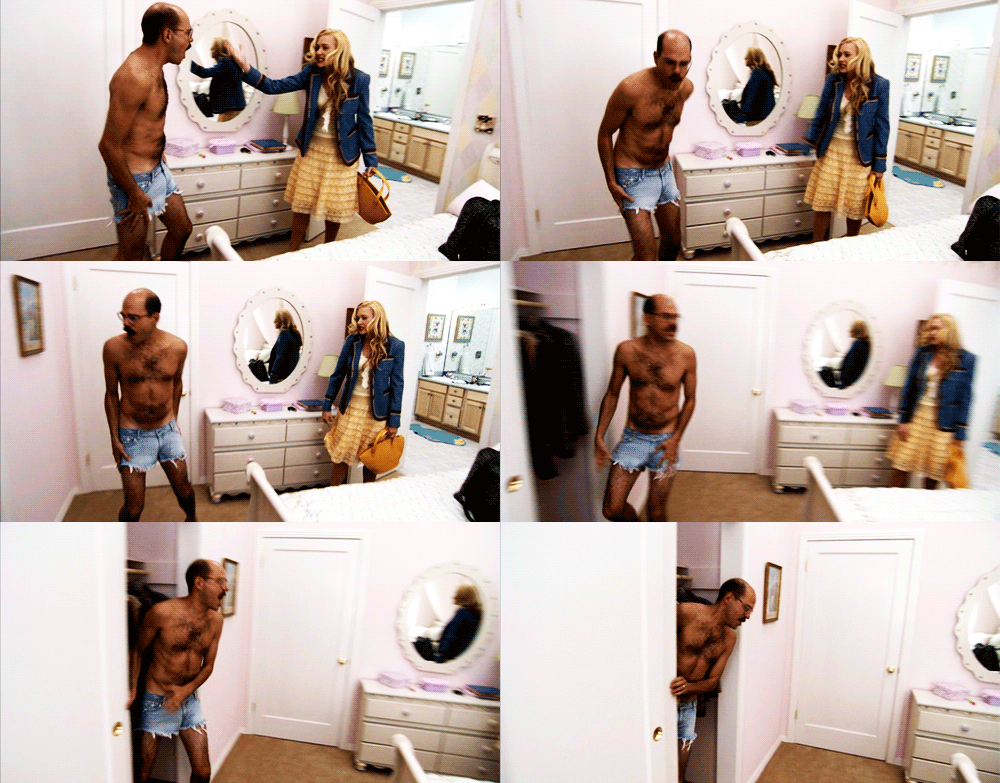
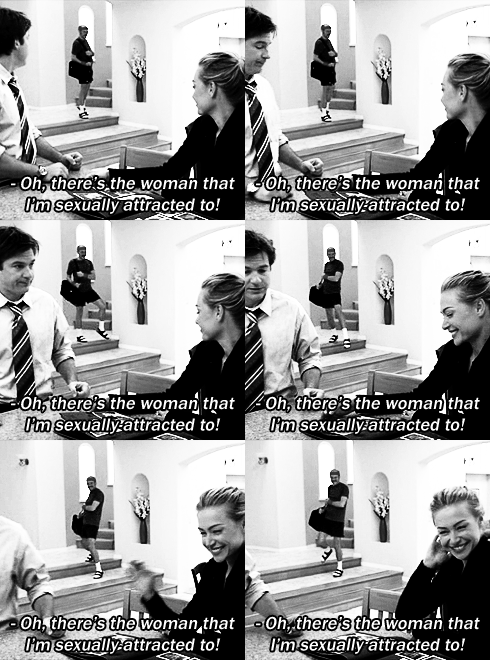
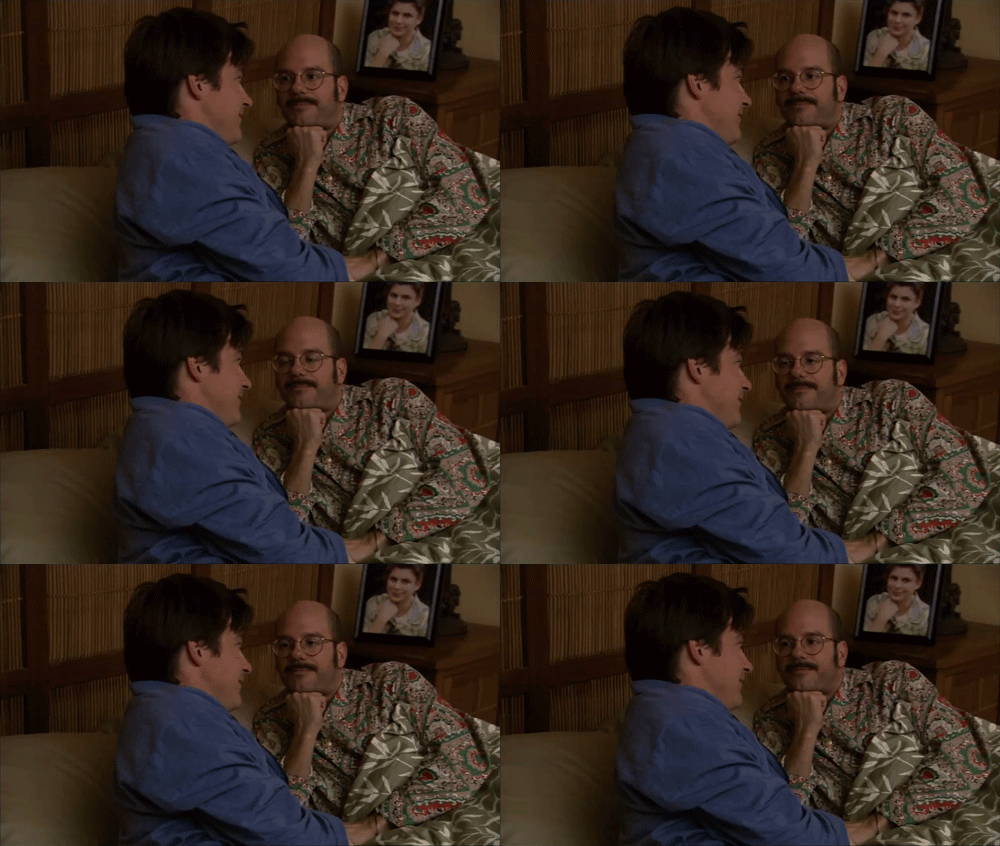
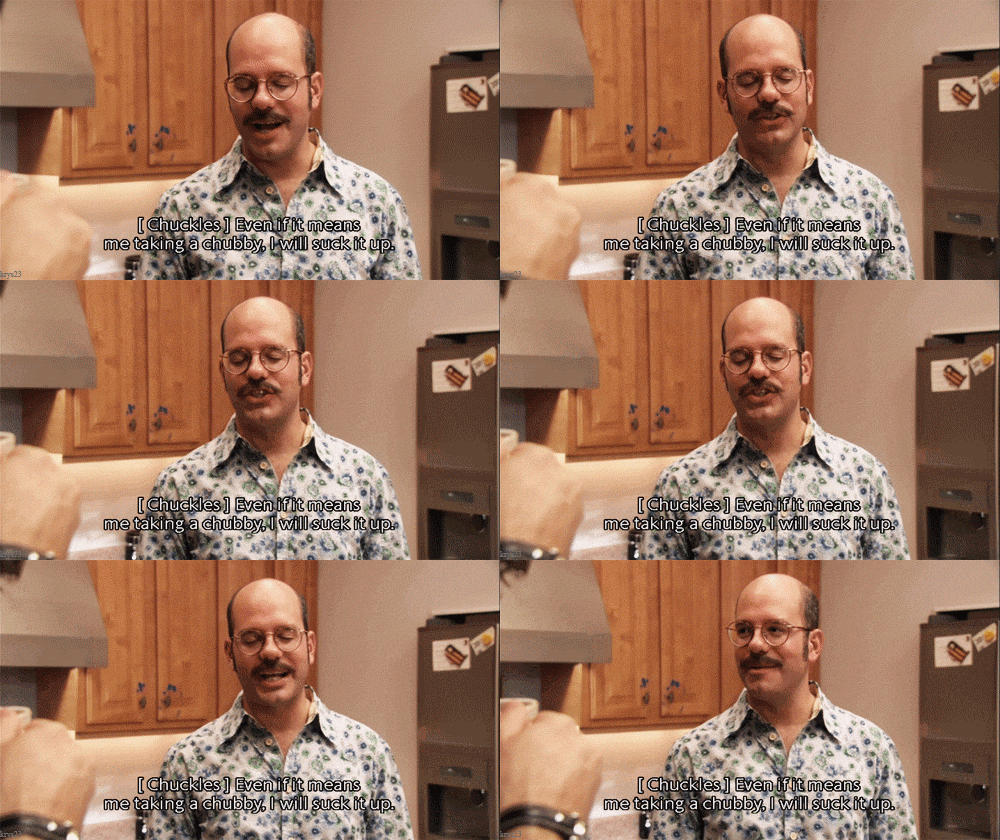
Waiting Till The Wedding Night, Helpfully Explained By The Bluth Family

Inspired by Jezebel's GIF parade to explain the recent Fox News "opinion" piece on waiting until marriage, I present to you...


As anyone who’s read my abstinence column here at Fox News Opinion could guess, my wedding is something that I’ve looked forward to for quite some time. After having tied the knot at the end of August, I can now say beyond all shadow of a doubt, that it was everything I’d hoped and prayed that it would be since childhood. (I’d also prayed to be bitten by a radioactive spider and develop sticky hands, but… I was an idiot.)

Let me preface this column by saying this: my wife (I have to get used to saying that) and I not only waited sexually in every way (no, we didn’t pull the Bill Clinton and technically avoid “sex” sex,)...

...but we didn’t shack up as live-ins and most importantly, we courted each other in a way that was consistent with our publicly professed values.
We did it right.

Feeling judged? I couldn’t care less. You know why? Because my wife and I were judged all throughout our relationship. People laughed, scoffed and poked fun at the young, celibate, naive Christian couple. 
  We’d certainly never make it to the wedding without schtupping, and if we did, our “wedding night would be awkward and terrible,” they said. 
Turns out that people couldn’t have been more wrong.  Looking back, I think that the women saying those things felt like the floozies they ultimately were, and the men, with their fickle manhood tied to their pathetic sexual conquests, felt threatened.
I think it’s important to write this column not to gloat (though I’ll be glad to), but to speak up for all of the young couples that have also done things the right way. When people do marriage right, they don’t complain so much, and so their voices are silenced by the rabble of promiscuous charlatans, peddling their pathetic world view as “progressive.”
 
Our wedding was perfect.
 Our wedding night was nothing short of amazing.
I write this on a plane heading into a tropical paradise with the most beautiful woman to have walked the planet earth. I know everybody says that their bride was the “most beautiful in the world.”  They’re wrong. I win.

I’d like to tell you a story of our morning after, however. One that transpired into one of the most glaring epiphanies I’d ever had.
 
As my wife (again, still not used to that) and I ate breakfast at a local inn, we discussed how excited we were to start the rest of our lives together, how scary it was that everything was now so different. At the same time, we overheard the table next to us discussing their very own wedding from the night prior. What a coincidence!

“The thing is, nothing’s really changed,” the bride said.

Puzzled, my wife asked, “Did you get married last night too? So did we!”

“Congratulations!” the other dame said. “Yeah we did, just last night.”

“Where’s the groom?” my wife innocently… scratch that, naively asked.

“Oh, he’s sleeping. There was no way he was coming out with me this morning!” She paused and smirked. “Let’s just say that he’s got a lingering headache from a really good time last night.”
My heart sank. Firstly, that poor schmuck's “good time” was simply getting snookered. Not enjoying the company of close family and long-lost friends with a clear head and clean conscience, not staring in awe at his beautiful new wife, wanting to soak in every glimmer of her eyes as she shot him heart-racing looks from across the dance floor, not taking all of the cheesy pictures as they cut the cake, not even carrying her across that suite threshold as they nervously anticipated their “nightcap.”

He probably won’t remember any of it. Instead, he got smashed. He was “that guy”… at his own freaking wedding.
Then I realized something. Our wedding was truly a once in a lifetime event. It was a God’s-honest celebration of two completely separate lives now becoming one. Physically, emotionally, financially and spiritually, everything that made us who we were individually was becoming what bonded us together. Our family traveled from far and wide to celebrate the decision of two young people to truly commit themselves to each other, and selflessly give themselves to one another in a way that they never had before that very night.
The people next to us that morning? Well, theirs was just one big party.  And the morning after? Just another hangover.
Our “weddings” were the same event in name only. They know it, and we know it.
Do yours the right way.  If you’re young and wondering whether you should wait, whether you should just give in, become a live-in harlot/mimbo and do it the world’s way.  
If you’re wondering whether all of the mocking, the ridicule, the incredible difficulty of saving yourself for your spouse is worth it, let me tell you without a doubt that it is. Your wedding can be the most memorable day and night of your life… or just another party.

Oops. Did I just make a “judgment?”  You’re darn right I did.

Thursday, September 20, 2012

The Waiters

So this came to my attention today.

Okay, for the record, being sex positive means not judging people for their sexual tastes and practices. And that includes not judging folks who, how to put this, "wait" until they're married to do the deed. I certainly don't judge the author of the above article for his relationship choices, despite the fact that he probably thinks I do. Don't get me wrong, I think it's a way outdated concept riddled with oppressive societal norms, but as a friend of mine likes to say, "If abstinence is your fetish, who am I to judge?"

The issue I have with "The Waiters" is that they're so fucking high and mighty about it. They think that the rest of us - the slutty promiscuous sinners who surely will never find true happiness because we just "give it away" to anything that moves - actually want the same things but just don't have the strength or moral integrity to "do things right."

WHICH IS PATHETIC. It's a dream world. I never harbored some uber-sanctified idea of my "virginity." I don't believe "virginity" is even a real physiological state; to me, it's a social construct kept locked up behind a facade of bunk science and poor understanding of reproductive anatomy. And again, if you want to place value on the concept of virginity, then by all means. That's your business. But don't start pulling information from a 19th century textbook to tell me that all women bleed like a slaughtered pig the first time they have intercourse.

So no, I never saw much value in waiting until marriage, in the concept of my supposed "virginity." Does that mean I don't respect myself or my body? Have poor self esteem? Need to "give it up" to keep a man around? Hardly. Let's look at the facts: I have never had sex with someone because I needed to be validated. The only time I've ever had sex under any kind of pressure that surpassed my own autonomy was in a bad relationship that needed to end (a married relationship, at that).

Bad relationship drama aside, I have remained very sexually autonomous in a world that would love to see me otherwise. To start, I was very well educated, mostly by my private (but not religious) school which actually taught comprehensive sex education. The first time I had sex, I was just a few days shy of 17. My boyfriend and I talked it over, we evolved to a place where becoming sexual with one another was something we were both comfortable with, and oh yeah, WE USED PROTECTION. And you know what? I don't regret a thing.

I understand that I'm treading into becoming high and mighty myself, so I want to interject here that I am not trying victim blame. I understand that sexual relationships are far too often entered into for unhealthy reasons, and I believe good, moral people fall into the traps set by a system of inequality between the sexes. So let me say this: anyone who manipulates someone else into having sex with them is a stain upon the wonderful world of human sexuality. The people who fall for it are generally socialized to do so by a system of capitalist patriarchy, which teaches us (particularly those of us with girl parts) that sex is a commodity to be bought and sold while simultaneously shaming us for taking part in it. (Consequently, this is the same system that the aforementioned author likely aligns himself with... food for thought.)

But back to the article. "Oh, we're so much better than that woman who's husband is sleeping it off because we actually feel different today!" You ever stop to think that maybe that couple doesn't want your life? That they don't want your marriage? That they simply didn't perceive their wedding to be this sudden, life-altering event, but rather a wonderful milestone in an already-evolving relationship?

Naw, they wanted to wait, to not live together first. They just fell to temptation. They're weak. Their morals are in shambles. Your way is so much better.

Fuck your understanding of morals. Morality isn't something you abide by just because some centuries-old book tells you to. Morality is something you have internalized for yourself, and even if it does come from a religious influence, you've still internalized it for personal reasons. I'm a very moral person, but for a number of reasons I could never internalize the kind of morality that your religion pushes. However, I do have extremely clear guidelines for how I handle everything from conflict to sexuality, and I very rarely waiver on any of it. One of my favorite morals is non-judgment. As I've said, I don't judge The Waiters. That's their business. But I have a very clear moral duty to call them out on their bullshit when I see them doing harm by passing moral judgment on others.

"Oh, but marriage is just the way to go." Right, because sexual relationships are always great if you're married. People never use sex to manipulate their partners in a marriage. A married man never rapes or sexually assaults his wife. All relationship problems would just magically be solved if everyone would just get married.

Whatever. I hope he and his wife enjoy a long and happy life in whatever alternate reality they currently reside in.

Enough ranting and cursing for now... Jezebel makes it better with all the hilarious GIFs.

Monday, September 3, 2012

Newsflash: It's Not Unusual To Measure Pregnancy From Two Weeks Prior To Conception

The following is a cross-post from RHRealityCheck.org
------------------------

Dear Everyone,
Please stop referring to Arizona's new abortion ban as the "Pregnancy Begins Two Weeks Before Conception Act."  It's an ill-informed statement and makes us all look like we don't know what we're talking about.  Plus, it focuses on the wrong aspects of the bill.

First of all, from a health care standpoint, pregnancy is nearly always measured from two weeks prior to when implantation (the physiological beginning of pregnancy) actually occurs.  All clinicians - doctors, midwives, the good folks at your local Planned Parenthood - measure pregnancy not from how long a person has actually been pregnant, but from their last menstrual period (LMP), which falls about two weeks prior to implantation.  This is partly because we don't always know exactly when a person actually became pregnant, but mostly because it's far more accurate to measure a person's unique gestation rate by her cycle. 

In other words, if I was pregnant and had my last menstrual period on July 23, I would be classified as "six weeks pregnant" even though I've probably only been pregnant for about four.  This is not unusual, and all clinics that provide abortions measure your pregnancy this way.

Now, let's instead focus on the real problems with this bill.  The ban on abortions after the 20th week LMP (18 weeks gestation, for those of you playing along at home) is an arbitrary marker backed up by the idea that fetuses feel pain after this point (there in fact is no evidence to support this claim).  My own state of North Carolina has had this ban in place for years, as do Alabama, Louisiana, Kansas, Idaho, Indiana, Nebraska, and Oklahoma. The Arizona bill also requires women to have an ultrasound 24 hours to having an abortion, requires clinics that provide abortions to be held to higher standards than most other outpatient surgical facilities, and states that providers must have admitting privileges in local hospitals (again not something that is generally required of practitioners operating in other kinds of outpatient surgical centers).  In other words, the Arizona bill is a major attack on abortion access, not just a bill that challenges our understanding of gestational measurement.

So really, instead of calling it the "Pregnancy Begins Two Weeks Before Conception Act," I'd like to suggest the following alternatives:
  • The "Let's All Use Bunk Science To Legislate When A Fetus Feels Pain" Act
  • The "Arbitrary Guidelines On Gestational Restrictions For Abortion" Act
  • The "Women Are Incapable Of Making Their Own Decisions" Act
  • The "State-Sanctioned Rape" Act (to borrow from the Virginia bill passed earlier this year)
  • The "Let's Place So Many Restrictions On Who Can Provide Abortions That No One Can" Act
The above suggestions don't necessarily roll off the tongue, and to be sure they don't make for decent soundbites either.  But they would keep this whole mess from becoming known as the "Pro-Choice People Don't Know Anything About Pregnancy" debacle. 

Your Friendly Full-Spectrum Doula,
Lauren

Saturday, September 1, 2012

FYI - Breastfeeding Certifications

You know those letters after a doula's name that don't necessarily have to do with being a doula? Often those are credentials from different (but related) organizations and may indicate a specialty in a number of birthy areas: childbirth education, massage and bodywork, breastfeeding support, placenta encapsulation, nursing, etc.

There are many credentials that revolve around lactation, which can often be confusing when an already-exhausted family is searching for the right kind of support. Each of the below certifications qualifies one to offer a certain level of breastfeeding support, however, the IBCLC is the only credential that is qualified to provide clinical assessments and address the full scope of lactation challenges.

The following list lays out what each certification means, how one certifies, and the scope of practice associated with each.

IBCLC - International Board Certified Lactation Consultant - This is a clinical credential that requires several thousand hours of required study, education and training culminating in a once per year international exam given by IBLCE. IBCLCs must rerecertify every 5 years, and every 10 must retake the exam. These clinicians work in hospitals, birth centers, out of their homes, and in private practices. They perform complete evaluations and assessments of both mother and infant and create individual plans of care, working hands on with all breastfeeding challenges as well as more complex health issues.
*Sidenote: I took the IBLCE exam this past July and am waiting on my results, which will be mailed in October.  Fingers crossed! :)

RLC - Registered Lactation Consultant - This credential is used in conjunction with IBCLC within the United States.

CLE - Certified Lactation Educator - CLEs have completed a 20-hour course on breastfeeding support and completed approximately 25 additional hours of out-of-class coursework which culminates in a certificate of completion from CAPPA. CLEs are trained to teach breastfeeding classes and answer basic breastfeeding questions, however, they must refer out to IBCLC for more complex cases and are not trained for hands on consults.

CLC - Certified Lactation Counselor - CLCs have completed a 45 hour course of education, culminating in a certificate of completion, sometimes after completing an end-of-course exam, from The Center for Breastfeeding. They are trained to counsel on normal breastfeeding situations and troubleshoot minor challenges, however, they must refer out to an IBCLC for more complex cases and are not trained for hands-on consults.
*Sidenote: I completed this course as a stepping stone towards the IBCLC. I highly recommend it for any doula or childbirth educator who wishes to hone in on their lactation support skills, or anyone who's considering sitting for the IBLCE exam.

CLS - Certified Lactation Specialist - Similar to CLC, CLSs certify through Lactation Education Consultants by attending a 45-hour course and completing an end-of-course exam. They are trained to educate, support, and counsel mothers on normal breastfeeding situations, however, are not qualified to perform hands-on consults or administer clinical plans of care.
*Sidenote: I know of several doulas who have spoken very highly of this course as a supplement to their doula services, or as a stepping stone to the IBCLC.

BEC - Breastfeeding Educator Certification - Those who hold a BEC have completed an intensive course of study with Birth Arts International. Prospective BECs complete a lengthy in-classroom or self-study course on the science of lactation, anatomy and physiology, pedagogy, sociology, medical terminology, and counseling. They must also complete 600 hours of supervised lactation support in varying clinical settings in their communities.  The BEC certification is community-specific and qualifies students to teach, support, and educate the public on breastfeeding and related issues and policies. 

BC - Breastfeeding Counselor - A relatively new organization, Breastfeeding USA certifies mothers to lead free, highly accessible support groups for breastfeeding mothers. They answer questions regarding normal breastfeeding situations, offer tips for troubleshooting challenges, and refer out to IBCLC support when indicated. 

LLLL - La Leche League Leader - La Leche League International is the oldest breastfeeding support organization in the country, now offering support groups all over the world. LLL leaders receive a multitude of training in normal breastfeeding situations, offering tips for troubleshooting challenges, and know when to refer out to IBCLC support. Offers mom to mom support in a casual and accessible environment. Many IBCLCs started as LLL Leaders.

WIC Certified Breastfeeding Peer Counselor - WIC CBPCs are employed by state WIC offices and provide support to breastfeeding mothers who qualify for WIC at no additional cost. While the requirements vary state by state, WIC Peer Counselors are mothers who have breastfed themselves and have completed comprehensive study in breastfeeding management, counseling, cultural diversity, and education.

Monday, August 27, 2012

Our Foreskins, Ourselves

A number of people have asked me my opinion on the new American Academy of Pediatrics statement on infant circumcision, released today. But y'all know I'd have my opinion out there even if I hadn't been asked, so here it is:
  • The background: It appears the AAP has taken the same body of evidence they've used for the past 13 years plus one new study and somewhat reversed their stance. Despite the hype that the AAP now "recommends" routine circumcision, what the AAP has done is take into account one new study on HIV transmission and is now saying that "the benefits may outweigh the risks." While this is a stone's throw from actually recommending routine male circumcision, it's close enough, and future parents will take it to heart.  Sidebar: The AAP is now the only major pediatric association in the world that does not clearly oppose routine infant circumcision.
  • While they have added a single study on HIV transmission, the study they are actually referencing cites VOLUNTARY male circumcision, as in, by choice at an adult age, in areas of the world where HIV rates are astoundingly high. This has led to the idea that circumcision at birth somehow protects men from contracting STIs later in life. However, among industrialized countries, the U.S. ranks high in both STI transmission rates (including HIV) and percentage of boys circumcised at birth. In other words, we don't even have correlative evidence to back up this claim. Of course STI transmission is a big concern to me personally, but I don't see how removing a functional part of a boy's penis at birth is going to somehow protect him from contracting an infection later in life. To address this issue, I'd advocate instead for a) comprehensive sex education in schools, b) more funding for youth programs that encourage and increase access to safer sex practices, and c) a society that isn't so sex-negative that things like condoms and penises can't even be discussed in a frank and honest manner.
  • Regarding the "penile cancer" risk: Penile cancer is extremely rare. When it does occur, it usually manifests in what we call the "foreskin" of the penis. So by removing the foreskin at birth, a male infant will grow up to be less likely to develop a cancer that he was already unlikely to develop in the first place. By this logic, we should also be removing the breast buds of baby girls. Think about it... breast cancer manifests in the functional breast tissue, the basis for which is present at birth. And seeing how breast cancer is far more common than penile cancer, we should be taking every possible precaution. We'll do it when they're two days old, so they won't remember it. We'll use anesthesia, so they won't feel it. And if they want to have kids later in life, well, they can just feed their babies with infant formula. And besides, women can still get some sexual pleasure without their breasts being involved. (See how ridiculous this sounds?)

  • This is just speculation, but... given the fact that more and more insurance companies (and Medicaid) is seeing infant circumcision as a cosmetic procedure, they tend to not cover the costs. Perhaps the AAP is changing their position so they can continue performing the procedure regularly (cough cough cha-ching cough cough). Again, just speculation.
At this point, the sex-positive person in me wants to rail on and on about the sexual implications of removing the nerve-rich foreskin at birth, but instead I'll let Laci Green break it down for us:


Further Reading:
Doctors Opposing Circumcision: Commentary on American Academy of Pediatrics 2012 Circumcision Policy Statement (pdf)
Intact America
The Whole Network